CONTROLLED AGENCY | Issue 11: The Confidence Paradox
Why Organizations Trust AI Governance That Has Already Failed

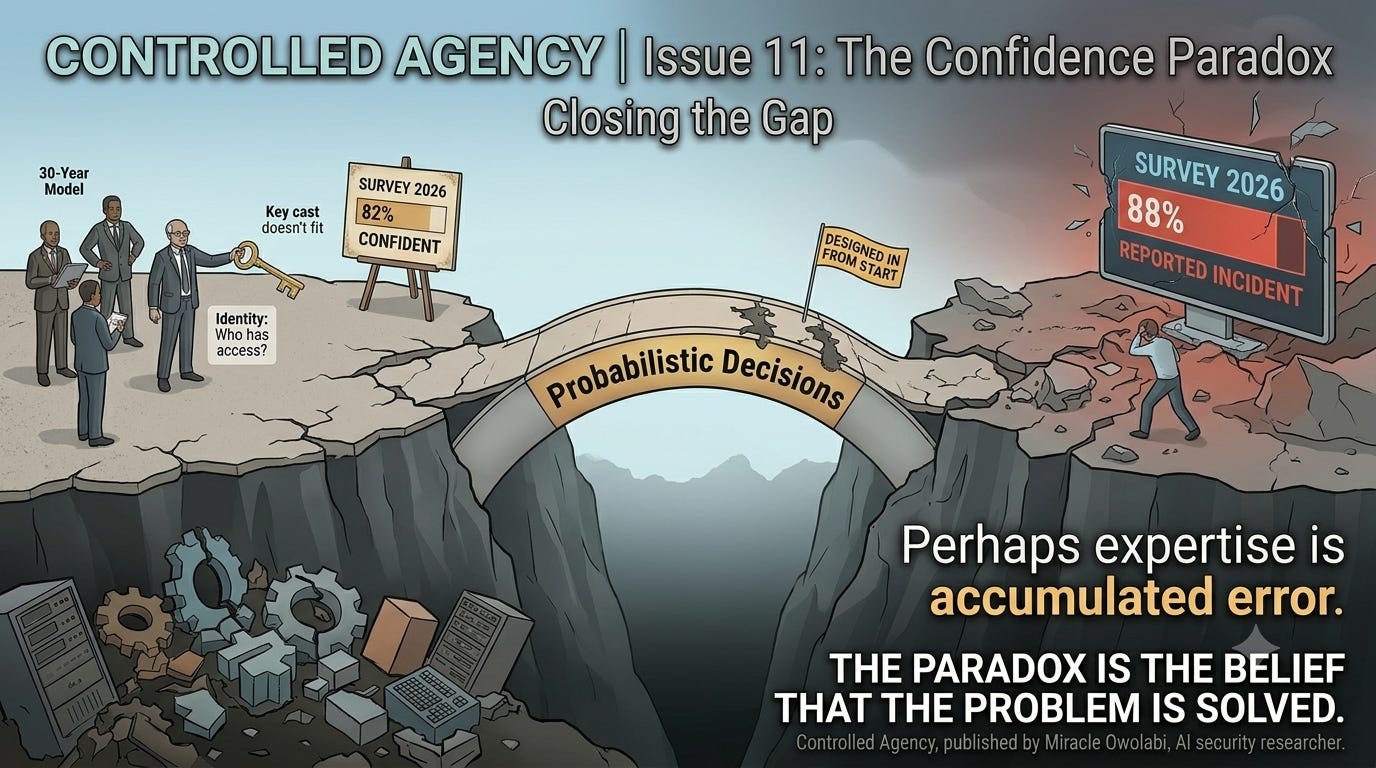
In a survey, 82% of security leaders said they were confident their agent controls worked. In the same survey, 88% reported an agent security incident in the past year.
Sit with that pairing for a moment. One survey. One population of security leaders. Most of them are confident that their governance works. Nearly all of them have already breached.
This is the confidence paradox, and it is the defining condition of enterprise AI security in 2026. It is also the reason the previous nine issues of this newsletter exist. Every technical argument made here, the monitoring gap, the enforcement gap, the identity vacuum, the memory problem, the experience hijack, converges on a single organizational failure that the survey data has now made impossible to look away from. Organizations cannot see what their agents are doing, cannot constrain what their agents can do, and cannot prove what their agents did. And the people responsible for those organizations believe they are protected.
This issue is about why that belief persists, what the gap between confidence and reality actually is, and what closing it requires.
The disconnect at the center
The confidence paradox is not a story about negligence. It is a story about a mental model that worked for thirty years and stopped working when the thing being governed changed shape.
A human user authenticates, takes an action, and leaves a trail. The behavior is intermittent, bounded, and readable by traditional security tooling. The model that security leaders carry, the one that produces their confidence, was built on that behavior over three decades. It is a good model. It is just a model of the wrong thing.
AI agents violate every assumption in it. They run continuously across multiple systems rather than intermittently, retrieve context dynamically rather than operating on fixed inputs, make probabilistic decisions without explicit instruction rather than executing deterministic commands, and chain actions across workflows in ways that are hard to reconstruct afterward, rather than producing clean, linear logs.
When a security leader says their policies protect against unauthorized agent actions, they almost always mean they have decided which agents exist and what those agents can access. That is the question traditional tooling was built to answer, and it is the wrong question.
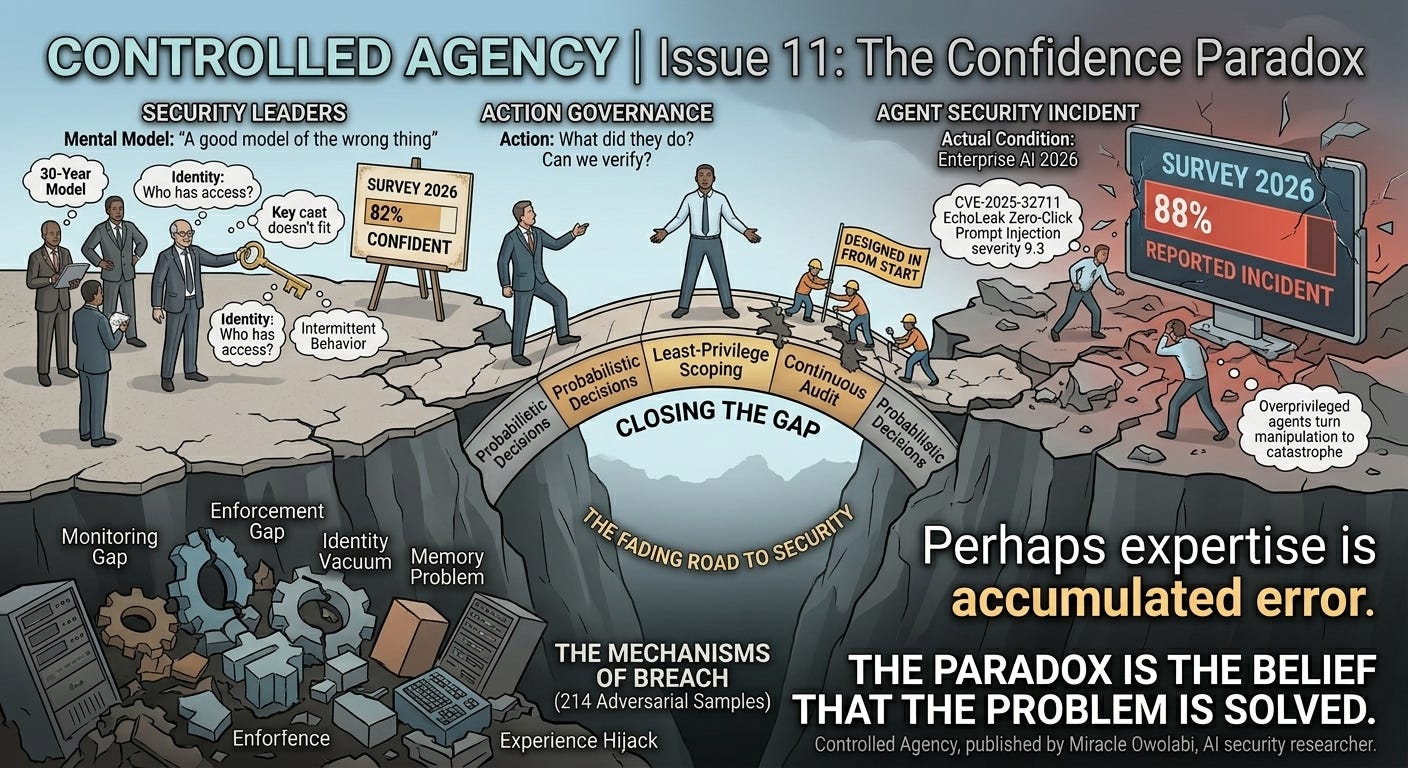
Here is the distinction that the entire paradox turns on. Identity governance asks: who has access? Action governance asks: what did they do with it, can we verify it, and can we prove it to a regulator afterward?
Most enterprises can answer the first question. Almost none can answer the other two.
The confidence comes from answering the access question correctly; the incidents come from never having addressed the action question at all, and the executive is confident about the lock on the front door, while the building has no interior walls.
The execution layer is where the attacks actually land
Security teams have done real work on the model layer. They have controlled which AI tools employees can use, which vendors pass procurement, and what data those tools can see. That work matters, and it is not wasted.
But it leaves the execution layer untouched. And in 2026, the execution layer is where agent attacks actually happen.
When an agent takes an action, it does so through a tool invocation.
It calls an API, writes to a database, triggers a workflow, and pushes instructions to a connected system. This is the precise point where AI reasoning meets production infrastructure.
At most enterprises, tool invocations are trusted by default, with no risk scoring before execution, no policy enforcement at the connector level, and no audit trail of what the agent actually did.
The documented incidents of 2026 live at this layer.
The clearest public example is EchoLeak, assigned CVE-2025-32711, a zero-click prompt injection in Microsoft 365 Copilot rated 9.3 in severity, where an attacker sent a single crafted email containing hidden instructions. When Copilot ingested that email during routine summarization, it followed the hidden instructions, pulling data from connected systems and exfiltrating it through a trusted domain. Antivirus, firewalls, and static scanning were all ineffective because the exploit operated in natural language, not code. It required no user interaction at all.
That is an execution-layer failure in its purest form.
The model layer was fine, and the agent did exactly what an agent does: read content and act on it. The failure was that nothing sat between the agent’s reasoning and its tool invocation to ask whether the action it was about to take was one it should take.
Securing the model layer while leaving the execution layer ungoverned is the structural form of the confidence paradox. The work that has been done is visible and reassuring. The work that has not been done is invisible until an incident makes it visible.
The accumulation problem inside the paradox
There is a finding in the recent enterprise security literature that connects the confidence paradox directly to the empirical research this newsletter has documented since Issue 02.
Agents with long conversation histories are significantly more vulnerable to manipulation because cumulative context can gradually shift the model’s effective constraint boundary. Multi-turn resilience has now been named by enterprise security researchers as a metric that must be tracked separately from single-turn jailbreak resistance, specifically for agents that operate over extended sessions.
This is the Accumulation Problem arriving in the mainstream conversation under a different name. In our own research across a reproducible 214-conversation benchmark of multi-turn agent attacks, per-request monitoring gave 0% pre-critical warning, structurally, a guardrail that inspects one prompt at a time cannot alert before the critical turn, while trajectory monitoring caught most crescendo attacks a mean of five turns before exploitation. Even an aggressively tuned per-request guardrail reached only 36%. The reason this matters for the confidence paradox is that it explains why the confidence is so durable. The reason this matters for the confidence paradox is that it explains why the confidence is so durable.
An organization tests its agents against single-turn attacks, watches them pass, and reasonably concludes they are robust. The single-turn test is the source of confidence. But the attack that actually breaches the agent does not happen in a single turn. It accumulates across many. The test that produces confidence and the attack that produces the incident are measuring different things.
This is why per-request monitoring produces false confidence, specifically. It is not that it does nothing; it is that it does something visible and reassuring, catching individual malicious turns, while remaining structurally blind to the accumulation pattern that actually defeats it. The confidence is real, but the protection is not.
What closing the gap requires
The organizations that get this right are not retrofitting governance after deployment; they are designing it in from the start. The research is now explicit about what that means, and it maps to three controls this newsletter has described across ten issues.
1. Runtime visibility into what agents are doing, not just whether they were approved at deployment. Approved agents drift and can be manipulated. Behavioral monitoring at the session level catches the drift that deployment-time approval cannot see. This is the enforcement layer.
2. Least-privilege scoping for every agent. Survey data consistently suggests that organizations applying least-privilege controls to their agents experience substantially fewer agent-related incidents than those that do not, by a wide margin. The logic is simple: an agent operating with the minimum permissions its task requires cannot turn a single prompt injection into a full environment compromise. Overprivileged agents turn one manipulated interaction into a catastrophe. This is the identity layer.
3. Audit trails that are continuous and tamper-resistant, built into the agent-to-infrastructure stack rather than dependent on what agents choose to report upward. Governance that produces evidence, not just documentation. When an incident happens, and the data says it already has for most organizations, the difference between one that can reconstruct what happened and one that cannot is whether the audit infrastructure existed before the incident or is being improvised after it. This is the forensic layer.
These controls are not novel. They are the operational form of what NIST, the OWASP Agentic Top 10, ISO 42001, and the EU AI Act have all converged on specifying.
The gap is not that the controls are unknown, but that most organizations have not implemented them, and most of those that have stopped at the access layer.

The uncomfortable conclusion
The confidence paradox resolves in one of two ways for every organization currently inside it.
1. The first way is an incident that converts confidence into knowledge. The incident-rate data suggests most organizations have already taken this path, whether they have detected it or not, and a significant fraction do not know whether they were breached at all, which suggests many have taken it without realizing. This is the expensive way. Governance bolted on after an incident, once agents are operating at scale across distributed systems, is far harder to implement than governance designed in from the start. The surface is larger, the behavior is more complex, and the audit gaps compound with every workflow the agent runs.
2. The second way is to close the gap before the incident forces it. This requires more than just buying a tool. It requires security leaders to distrust their own confidence, to look at a governance posture that feels adequate, and ask whether it answers the access question while ignoring the action question. It requires treating that 82% confidence figure not as reassurance but as a warning, because the confidence and the incident rate came from the same survey.
The framing this newsletter has argued for, nine issues in, is no longer speculative. The survey data increasingly support it: the monitoring gap is real, the enforcement gap is real, and the identity gap shows up directly in incident rates. The confidence paradox is the organizational symptom that ties them together. The belief that the problem is solved is itself the largest remaining vulnerability.
The agents are already in production, and the incidents are already happening.
The only open question is whether your organization closes the gap deliberately or discovers it the way most already have.
Controlled Agency is published by Miracle Owolabi, AI security researcher. Subscribe at arksher.substack.com